You just spent thousands on a new IP camera system. High-resolution, AI analytics, cloud access from your phone. Six months later, cameras are dropping offline. Footage is choppy. One whole hallway goes dark at random. You call the camera manufacturer — they say the hardware is fine.
So what’s wrong?
The answer is almost always underneath the ceiling tiles: the cabling.
The Invisible Backbone
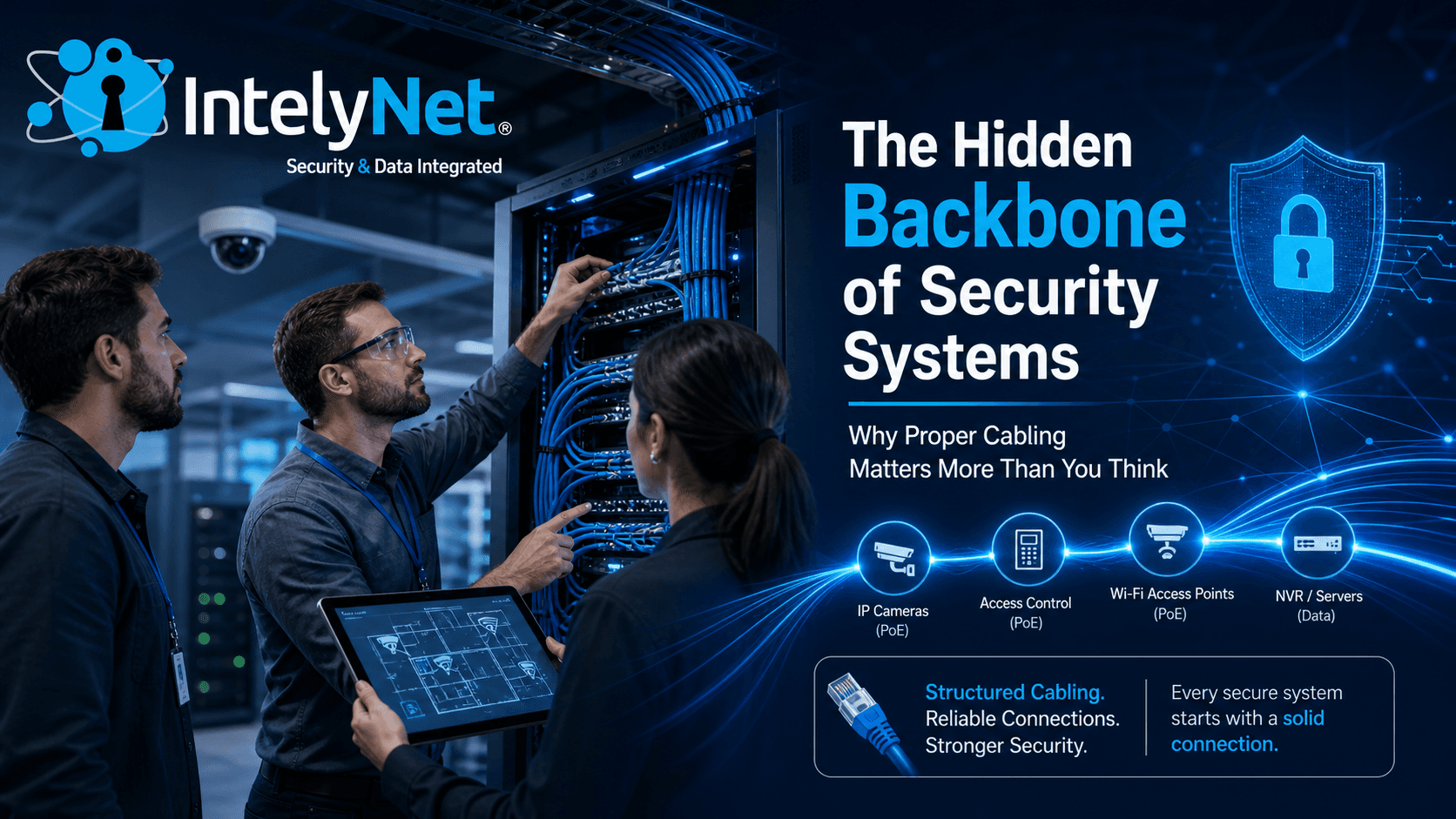
It’s easy to focus on the visible parts of a security system — the cameras on the wall, the access control panel by the door, the monitor in the front office. But every one of those devices depends on a network of cables running behind your walls, through your ceilings, and between your floors. That cabling is the circulatory system of your entire security infrastructure. When it fails, everything connected to it fails too.
The reality is that cabling problems are among the most common causes of video signal loss in surveillance systems. Damaged cables, loose connectors, incorrect cable types, and runs that exceed maximum distances all create issues that look like camera problems but are actually infrastructure problems.
What Goes Wrong When Cabling Is Done Cheaply
Not all low voltage installations are created equal. When cabling is treated as an afterthought — rushed during construction, done by the lowest bidder, or cobbled together during a retrofit — the consequences show up in ways that cost more to fix than doing it right would have in the first place.
Here are the most common issues we see:
Wrong cable for the job. IP cameras and modern access control systems require different cabling than old analog setups. Using Cat5e where Cat6 or Cat6A is needed limits bandwidth and creates bottlenecks, especially when you’re running AI-powered video analytics that demand consistent, high-speed data throughput.
Cable runs that are too long. Every cable type has a maximum effective distance. Cat6, for example, supports 10 Gbps but only up to about 55 meters in real-world conditions. Beyond that, you get signal degradation — which shows up as dropped frames, frozen footage, or cameras going offline during peak usage. We regularly encounter installations where cable paths were measured in straight lines on a blueprint rather than actual routing distances through walls and ceilings.
Poor termination. A single badly crimped connector can degrade signal quality across an entire line. Loose RJ45 clips, incorrect pinouts, and cheap connectors create resistance points that worsen over time as oxidation builds up. This is one of the most overlooked issues in the industry, and it’s the reason professional certification testing matters.
Cables running alongside electrical wiring. When low voltage cables share conduit or run parallel to high-voltage electrical lines, electromagnetic interference corrupts video signals and data transmission. This is especially common in retrofit projects where installers reuse existing conduits to save time. The result is grainy footage, static, and unstable network connections.
No cable management. Disorganized cabling isn’t just ugly — it makes troubleshooting nearly impossible and creates physical stress on connectors. Excess cable coiled behind equipment, cables pulled too tightly around corners, and bundles crammed into undersized pathways all accelerate wear and create failure points.
The PoE Factor
Modern security systems increasingly rely on Power over Ethernet (PoE), which delivers both data and electrical power through a single cable. This is incredibly convenient — but it also means your cables are working harder than ever. PoE++ can deliver up to 90 watts per port, and at that wattage, cable quality directly affects thermal performance. Cheap cables in tightly bundled trays can overheat, degrading performance and creating potential safety concerns. Cat6A is specifically engineered to handle this thermal load, which is why it’s become the standard specification for any serious commercial installation.
What Proper Cabling Looks Like
At IntelyNet, we approach every security project infrastructure-first. Before we talk about camera models or access control platforms, we assess the cabling environment. Our installations follow TIA/EIA, NEC, and BICSI standards — not because we have to, but because code-compliant infrastructure is the only kind that performs reliably over a 10-to-15-year lifecycle.
That means certified cable runs tested with professional equipment. Properly labeled and organized patch panels. Clean wire management that makes future maintenance straightforward. And a design philosophy that accounts for tomorrow’s technology, not just today’s requirements.
Because the truth is simple: a $300 camera on a $3 cable run will perform like a $3 system. Infrastructure is where security starts.
The Bottom Line
If your surveillance system is acting unreliable, don’t automatically blame the cameras. The problem might be behind the wall. And if you’re planning a new installation or upgrade, the single best investment you can make is ensuring your cabling infrastructure is designed, installed, and certified by professionals who understand that every system is only as strong as its foundation.
Ready to assess your building’s cabling infrastructure? Contact IntelyNet for a free consultation.