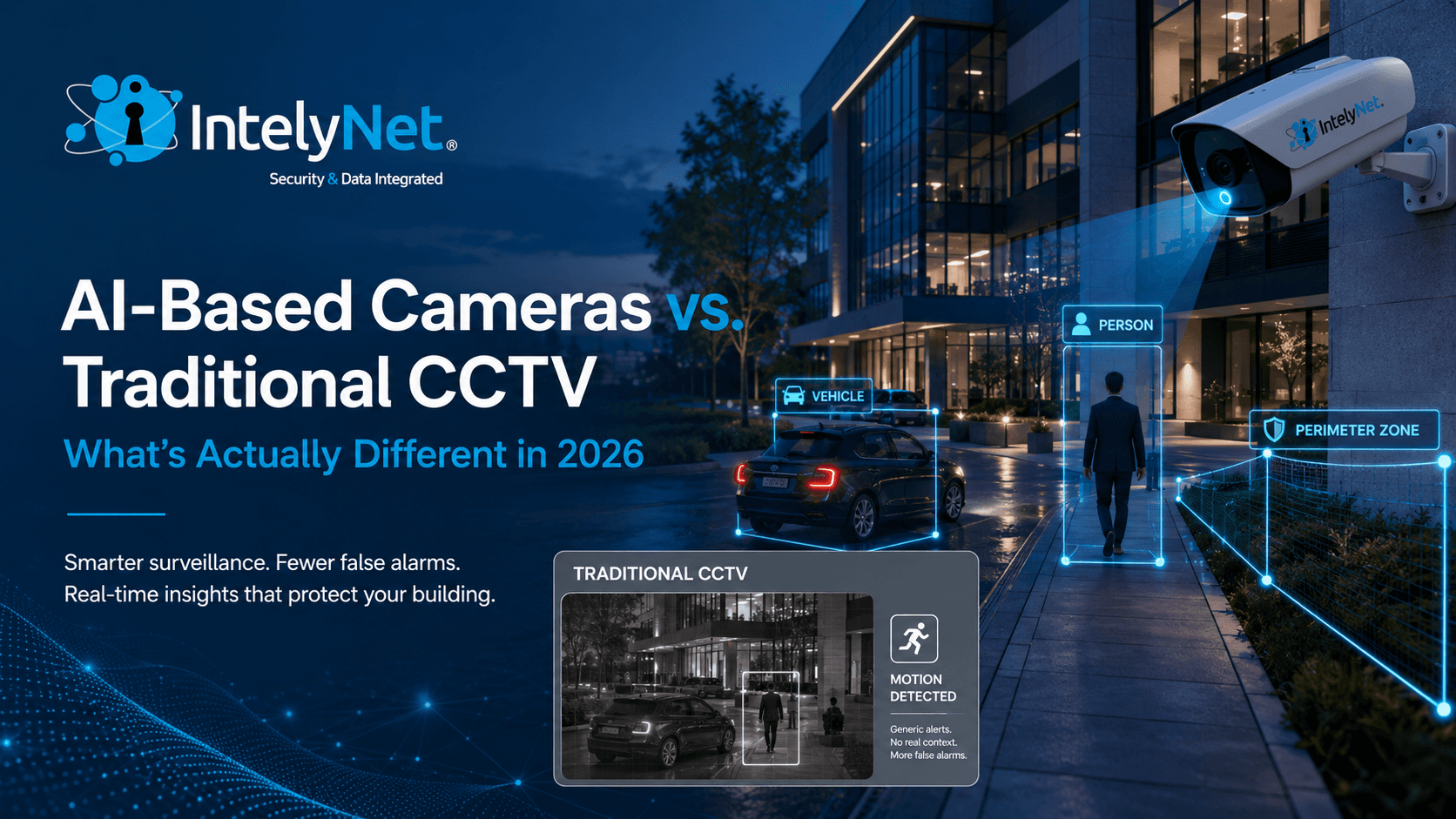
For most of the last two decades, a security camera did one job: it recorded video to a box in a closet, and someone reviewed that footage after something happened. It was reactive by design. If you wanted to know who broke into the loading dock at 2 AM, you scrubbed through hours of grainy recording the next morning, hoping the camera was pointed the right way.
AI-based cameras have changed what surveillance does. Instead of just recording, modern systems detect, classify, and respond to events as they happen — and they make the footage they capture searchable in seconds instead of hours.
If you're weighing an upgrade or specifying cameras for a new build, here's what actually separates AI-based surveillance from traditional CCTV in 2026.
What "Traditional CCTV" Means
Traditional CCTV systems are built around analog cameras feeding a DVR (digital video recorder), or older IP cameras feeding a basic NVR (network video recorder) with no intelligence beyond motion detection.
These systems still do the fundamentals. They capture video, they store it, and they let you play it back. For some low-risk applications, that's genuinely enough.
But they share a set of limitations that become more frustrating every year:
They're passive. A traditional camera records everything and understands nothing. It can't tell the difference between a person, a car, a stray cat, or a tree branch moving in the wind. Motion detection triggers on all of it, which is why most camera owners eventually turn off alerts entirely — they get too many false ones.
The footage is hard to search. Finding a specific event means manually scrubbing through hours of recording. If you don't know exactly when something happened, you may never find it.
Resolution and low-light performance lag. Many older analog systems top out at resolutions where you can see that a person was there but not who. License plates, faces, and other identifying details wash out, especially at night.
They don't integrate. A traditional camera system runs as an island. It doesn't talk to your access control, your alarms, or your intercom — so you can't connect a door-open event to the video of who walked through.
What AI-Based Cameras Add
AI-based cameras run deep-learning models either directly on the camera (edge processing) or on a connected server. Instead of just capturing pixels, they interpret what's in the frame — and that single shift unlocks everything else.
Object classification and detection. The system knows the difference between a person, a vehicle, a bag, and an animal. This is the foundation for everything else, and it's what finally makes alerts useful — you can be notified about a person in a restricted area at night without getting pinged every time a raccoon walks by.
Real-time facial, license plate, and object recognition. Modern systems can identify individuals, read license plates, and flag specific objects as events happen. A delivery truck pulling into your lot, an unrecognized face at a secured entrance, or an unattended bag in a lobby can each trigger an instant, specific alert.
Behavioral and anomaly detection. AI analytics can flag behaviors, not just objects — loitering, someone moving against the normal flow of traffic, a person climbing a fence, a crowd forming where one shouldn't. Audio analytics can detect sounds like breaking glass, raised voices, or alarms.
Geo-fencing and perimeter monitoring. You can draw virtual boundaries on the camera view and get alerted the moment someone crosses them — far more precise than blanket motion zones, with far fewer false alarms.
Thermal imaging. Thermal-capable cameras detect heat signatures, which means they see in complete darkness, through glare, and in conditions where standard cameras are blind. For perimeters, large outdoor properties, and low-light environments, this is a meaningful capability gap.
Custom alerts. Rather than one crude motion trigger, you configure specific alerts for the events that matter to your building — a person in a restricted zone after hours, an unrecognized vehicle in a reserved space, a door propped open too long.
The Integration Advantage
The biggest difference between AI surveillance and traditional CCTV isn't any single feature — it's that modern systems stop being a silo.
When your cameras integrate with access control and intrusion alarms on a unified platform, you get total site awareness from one interface. A credential used at a door instantly links to the video of who walked through. An alarm at the perimeter automatically pulls up the camera covering that zone. An after-hours entry attempt triggers a recording, an alert, and a log entry all at once.
This unified view is the difference between a security system you have to operate and one that actually works for you. Investigations that used to span hours of cross-referencing become a few clicks. And situational awareness shifts from "what happened yesterday" to "what's happening right now."
Do You Actually Need AI Cameras?
Not every building needs every feature — but in 2026, the gap has widened to the point where AI-based systems make sense for most commercial and institutional applications. A few honest guidelines:
Stick with simpler systems if you have a small, low-risk space, minimal traffic, and no need for alerts, search, or integration. Basic recording may genuinely be enough.
Move to AI-based cameras if any of these apply: you have valuable assets or sensitive areas, you've ever struggled to find an incident in old footage, you get too many false alerts (or turned them off), you need to monitor a perimeter or parking area, you want surveillance integrated with access control, or you simply can't have someone watching monitors around the clock.
The cost difference has narrowed considerably. AI-capable IP cameras are no longer a premium luxury — they're close to the standard spec for new commercial installations, and the operational value they deliver typically justifies the difference quickly.
What to Look for in Your Surveillance Partner
The camera matters less than the system design and the integrator behind it. Here's what separates a professional AI surveillance deployment from one that disappoints:
Right-sized analytics: A good integrator matches analytics to your actual risks rather than selling you every feature. Facial recognition at a daycare and license plate recognition at a warehouse loading dock are different needs.
Proper camera placement and resolution: AI analytics are only as good as the footage they analyze. Cameras need the right resolution, positioning, and lighting to let the AI do its job — a poorly placed 4K AI camera underperforms a well-placed one.
Genuine integration: Look for systems built on open standards (ONVIF) that integrate with your access control, alarms, and intercoms — not closed platforms that lock you into one vendor.
Scalable, future-ready design: Your system should be able to grow with your building and accept new analytics capabilities through software, not require a hardware rip-out every few years.
Single-source accountability: When one partner handles your surveillance, access control, and the cabling that connects it all, every system works together — and there's no finger-pointing when something needs attention.
The surveillance you install today will be the eyes of your building for the next decade. The difference between a system that just records and one that thinks, detects, and responds is the difference between hoping you catch something and knowing you will.